

The New Homes Ombudsman exists because the industry spent two decades telling buyers that defects in new builds were normal, temporary, and none of their business. That argument no longer works. For any UK developer active in the market today, the question is not whether a buyer can escalate a complaint - it is whether your internal process will hold up when they do.
What the New Homes Ombudsman actually is
The New Homes Ombudsman Service (NHOS) is the independent complaint-handling body for new-build homes in the UK. It sits alongside the New Homes Quality Board, which publishes and enforces the New Homes Quality Code - the set of standards that registered developers must follow from the reservation stage through to aftercare.
The combination matters. The Code tells developers how to behave. The Ombudsman tells buyers where to go when they believe a developer has not.
The three phases the Code covers
Developers often read the Code looking for a checklist of defects to fix. That is the wrong reading. The Code is structured around the buyer's journey - reservation, completion, and the first two years in the home - and sets behavioural expectations at each phase.
Pre-reservation and pre-contract
Clear marketing materials, transparent pricing, no pressure-selling, and a written reservation agreement that the buyer understands. Sales conduct is explicitly in scope. A complaint about a sales office promise that was never written down is a valid Ombudsman complaint.
Pre-completion and handover
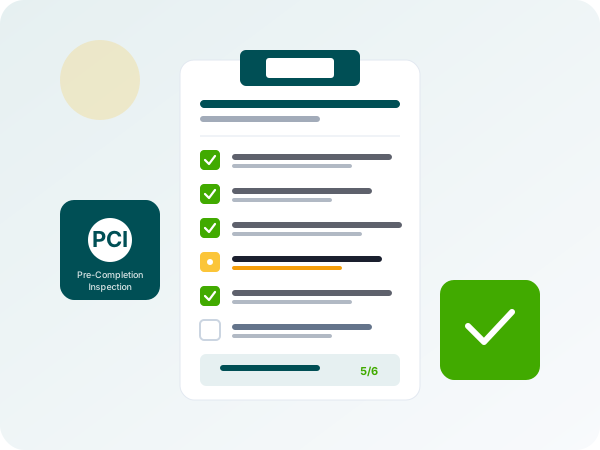
A meaningful pre-completion inspection (PCI) must be offered. The developer must give the buyer a reasonable chance to identify defects before legal completion and must document the outcome. Skipping the PCI, or running it as a tick-box exercise, is a common enforcement flashpoint.
After-sales and the two-year defect window
For two years after completion, defects that the developer is responsible for must be resolved inside documented timescales. The developer must provide a named contact, a clear reporting channel, and written responses. This is where most live complaints originate.
What triggers an Ombudsman complaint
A buyer can escalate to the Ombudsman only after exhausting the developer's own complaints process - or after an eight-week deadlock. In practice, the complaints that actually reach the Ombudsman share a recognisable pattern:
A defect the buyer reported repeatedly with no written acknowledgement from the developer.
A missed timescale that was never explained or renegotiated with the buyer.
Conflicting information between the sales office, the aftercare team, and the contractor who attended.
A repair declared closed when the underlying defect is still visible or still recurring.
The process developers need to have in place
The Code does not prescribe a specific system. It prescribes specific behaviours. The process that consistently passes Ombudsman scrutiny includes six elements:
A single, named intake point for every post-completion defect - not a shared inbox, not a phone line that rolls to voicemail.
Written acknowledgement of every report within a stated window (five working days is typical).
A documented classification of each defect against a published category list, so the timescale for response is predictable.
Photographic evidence of both the initial defect and the completed repair, tied to a specific plot and date.
A close-out note that explains what was fixed and what - if anything - remains outstanding.
A complaints register that tracks every reported issue, separately from repairs, so stage-one and stage-two complaints are visible to senior management.
Good record-keeping is the single most effective defence a developer has. It is also the single most common gap we see in cases that escalate.
- Paraphrased from New Homes Ombudsman published insights
Why this is now a reputational issue, not just a compliance one
Ombudsman decisions are published. Buyers researching a developer before reserving a plot can and do read them. A pattern of upheld complaints for the same category of defect - aftercare delays, handover issues, poor PCI practice - becomes a sales problem as much as a regulatory one.
The developers who have adapted most quickly treat their aftercare process as a product, not an overhead. The ones still running the old playbook - spreadsheets, emailed job sheets, ad-hoc contractor briefs - are the ones appearing in published determinations.
Bringing it all together
The New Homes Ombudsman has not changed the definition of a good new-build home. It has changed the consequence of managing defects badly. A developer with a consistent, documented, auditable aftercare process will rarely find themselves on the wrong side of an Ombudsman determination. A developer whose records cannot be reconstructed from first principles will spend a disproportionate amount of time there.
Defectly gives developers the intake, classification, evidence, and close-out trail the Code expects - in a single record per plot - so the Ombudsman conversation, when it comes, is about the repair, not about the paperwork.