
The question for most UK landlords is no longer whether damp and mould has to be taken seriously. That argument was lost some time ago. The live question is whether your response to a damp report would survive a regulator, a coroner, or a county court judge reading the record a year later. Under Awaab's Law, the answer depends less on the repair you carried out and more on what you can prove about how quickly you acted and how clearly you explained it.
Why the documentation question matters more than the repair question
Most landlords will, eventually, fix a damp problem. The pattern behind recent enforcement cases is not that landlords refused to act - it is that they cannot show when they acted, what they looked at, or how they communicated it to the tenant. A phone note, a scribbled job sheet, and an emailed invoice are not an audit trail. The Housing Ombudsman has been consistent on this point: even a competent repair, documented poorly, will be treated as a service failure.
Awaab's Law tightens this further because it sets statutory time windows. The moment a hazardous damp report is received, the clock starts. If your records do not pin that moment to a date, you cannot prove you were inside the window.
What Awaab's Law actually requires
The legal mechanism is a set of implied repair duties inserted into tenancy agreements by the Social Housing (Regulation) Act 2023. In plain language, three obligations matter.
Investigate promptly. Once a damp or mould hazard is reported, the landlord must begin an investigation within a defined statutory window and complete a written assessment.
Act on the findings. If the investigation identifies a significant risk, remedial works must start within a further defined window - not when the next slot happens to open in the contractor diary.
Communicate clearly. Findings, timescales, and the reasoning behind any decision to delay, defer, or substitute a repair must be shared with the tenant in writing.
Social housing today, private rented sector next
The first tranche of Awaab's Law applies to social landlords. The government has been explicit that equivalent duties are intended for the private rented sector through the Renters' Rights Bill, with a staged rollout. Private landlords who wait for the commencement order before changing their practice are betting on a very narrow gap between "expected" and "enforced".
The response clock in practical terms
The statutory timescales only make sense if they are mapped onto an operational workflow. For most landlords and managing agents, the working sequence looks like this:
Log the report. Capture the date, time, channel, tenant details, property, and reported symptoms - photographs if the tenant has supplied them.
Acknowledge in writing. Send the tenant a written acknowledgement with the reference number, next steps, and the inspection window.
Inspect and risk-assess. Attend the property, photograph affected areas, record moisture readings where appropriate, and classify the hazard.
Issue findings to the tenant. Share a written assessment explaining what was found, what will be done, and by when.
Remediate. Carry out the works and photograph the completed state against the original evidence.
Close and re-inspect. Schedule a follow-up inspection to confirm the cause has been addressed, not just the symptom.
What counts as sufficient evidence
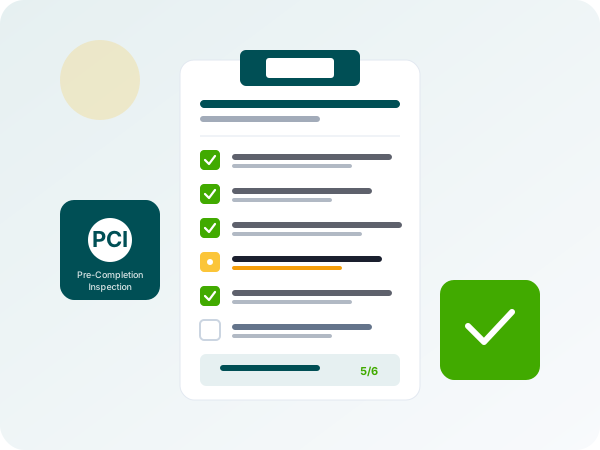
The evidential standard in a regulator review is not "did we fix it?" - it is "can an outside reader reconstruct the whole response from the record alone?" In practice, that means six types of evidence held together in one place:
Date-stamped photographs of each affected area, taken at first inspection and again at completion.
Location data tying each photo to the specific room, wall, or fitting - not just the property.
A written hazard classification against the HHSRS categories, including why a category was chosen.
All tenant correspondence in one thread: acknowledgements, findings letters, and any requests for access.
Contractor briefs and sign-offs showing what was instructed and what was completed.
A close-out note confirming the root cause and any residual risk flagged for future inspections.
The difference between a successful complaint response and an upheld maladministration finding is almost always the record, not the repair.
- Paraphrased from Housing Ombudsman insight reports
Where most landlord defences fail
Patterns repeat across complaint determinations. A response that was technically competent is undermined by failures that have nothing to do with the repair itself.
Unrecorded first contact. The tenant says they reported it in January; the landlord’s log starts in March.
Photos without context. Images exist but there is no way to tie a specific photo to a specific room on a specific date.
Communication in two systems. Contractor notes live in the jobs system; tenant correspondence lives in email. Neither tells the whole story.
Symptom closed, cause open. The mould is wiped down and painted over, but the underlying ventilation defect is never classified or referred onward.
No follow-up. The case is closed the day the contractor leaves, so a recurrence in month three reopens the original clock, not a new one.
A minimum viable damp response playbook
A defensible damp response does not require a large team or bespoke software. It requires a small number of things to happen reliably, every time.
Give damp and mould reports their own intake route so they are never absorbed into a general repairs queue.
Start the statutory clock from the date of first contact, not the date a case is opened internally.
Use a single record for each case covering photos, risk classification, tenant correspondence, and contractor sign-off.
Make the risk classification explicit in writing, even when it feels obvious.
Schedule a follow-up inspection before closing the case, regardless of whether the tenant requests one.
Audit a random sample of closed cases each quarter against the six-evidence checklist.
What tenants should expect and request
Tenants are not passive parties in this process. A well-documented response usually starts with a well-documented report. Anyone reporting damp or mould to their landlord should expect - and where possible, provide - the following:
A written acknowledgement with a reference number and a target inspection date.
Photographs of each affected area, taken from the same angles at different times if the problem develops.
A written assessment after the inspection, explaining what was found and what will be done.
A clear route for escalation if the landlord misses a statutory window - through the landlord’s complaints process first, and the Housing Ombudsman if it is not resolved.
Bringing it all together
Awaab's Law has not changed what a good damp and mould response looks like. What it has changed is the price of doing one badly. Landlords who can show, from a single case file, that they received a report, assessed it, communicated their findings, carried out the work, and verified the outcome will rarely have difficulty. Landlords who cannot reconstruct those steps from their own records - however good their actual work was - will find themselves defending the gap, not the repair.
Defectly is built for exactly that reconstruction problem: every defect tracked with photos, locations, status changes, and a complete audit trail that can be exported when it is needed most.